
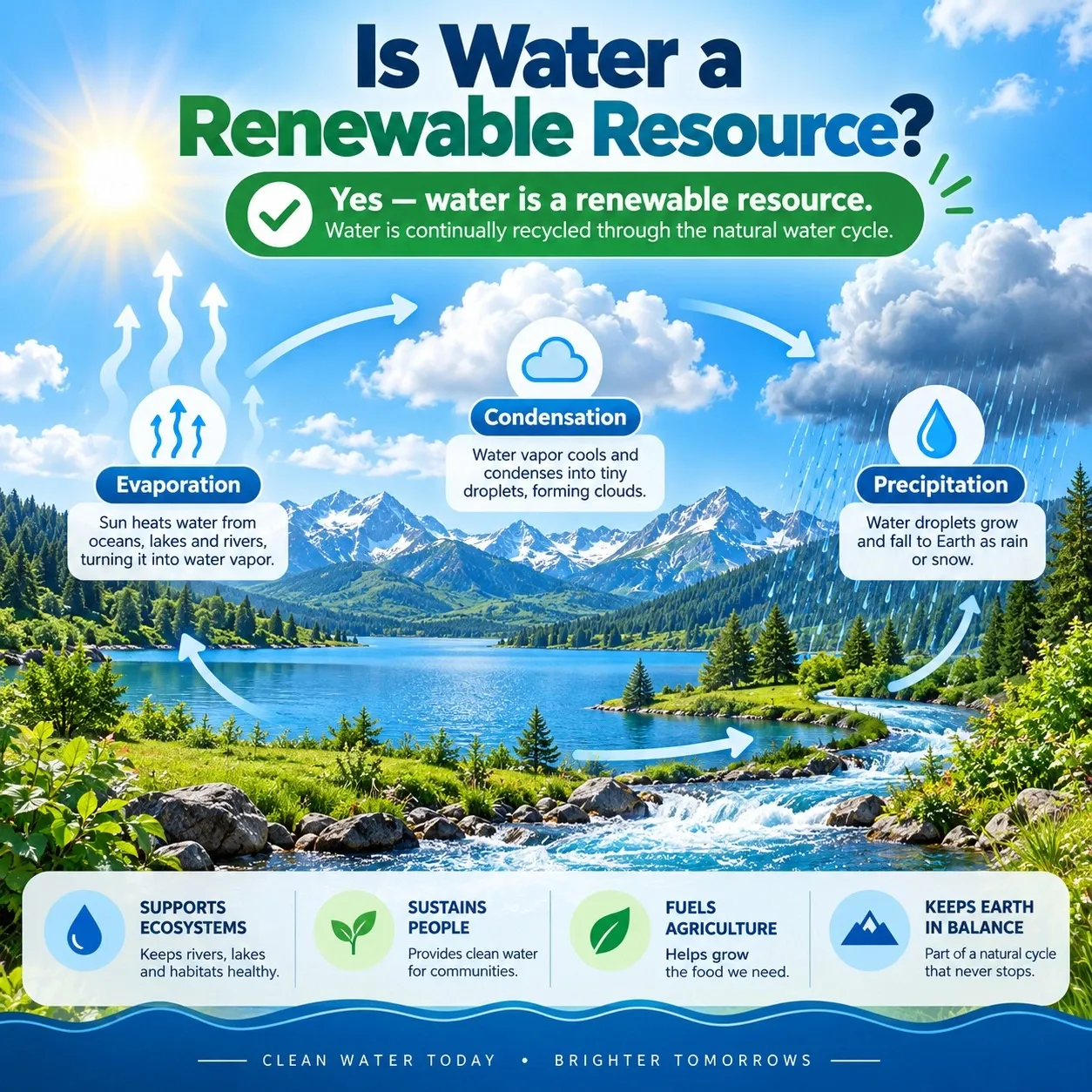

Do you drink water every day? Do you also use it for cooking, cleaning, and watering crops? This leads to a fair question: is water a renewable resource?
The short answer is yes. But there is a catch. Water comes back to us, but not always in the right place or at the right time.
Here, you will learn the whole story in plain words. We will also explain is water renewable or nonrenewable in clear steps. We will also look at is water a renewable source of energy and a simple test for which of the following is a renewable resource.
Some people also type is water renewable or non renewable resource into search, since the answer seems hard to pin down. Do not worry. We will make it simple.
Table of Contents
Is Water a Renewable Resource? The Quick Answer
Yes, water is renewable. Nature cleans it and gives it back to us again and again. No machine is needed.
So, is water a renewable resource in all cases? Mostly yes. But some water, like deep underground water, comes back very slowly. We will talk about that soon.
What Does Renewable Mean?
A renewable resource refills by itself. It does not finish when we use it. Sunlight, wind, and rain are good examples.
Think of a village well that fills up every rainy season. You take water out. Rain puts water back. That is how a renewable resource works.
What Does Nonrenewable Mean?
A nonrenewable resource does not refill in a human lifetime. After it is gone, nature cannot bring it back in time. Coal, oil, and gas are common examples.
They took millions of years to form. We burn them in minutes. That is why they are called nonrenewable.
A Simple Way to Remember
Here is a quick test. Can nature fill it up again soon? If yes, it is renewable. If no, it is nonrenewable.
Many people wonder is water renewable or nonrenewable, since water seems to disappear after use. But water never really leaves our planet. It only moves around.
Where Does Our Water Come From? The Water Cycle
The same water has been on Earth for billions of years. The water you drink today may have been a cloud last week. It may even have been in a river long ago.
This travel is called the water cycle. This is how water makes itself new again.
Step 1: The Sun Heats Water
The sun warms oceans, lakes, and rivers. A part of the water becomes a gas, which we call vapor. It rises into the air without a sound.
Step 2: Vapor Cools Down
Up above, the air stays very cold. The vapor cools and turns into tiny drops. These drops gather and make clouds.
Step 3: Rain and Snow Fall
When clouds get heavy, the drops fall as rain, hail, or snow. This water lands on hills, fields, roofs, and streets.
Step 4: Water Flows Back
Some water runs into streams and rivers. Some soaks into the ground. At last, a large share flows back into the sea.
Then the cycle starts again. It never stops. It is like a big, free recycling plant run by the sun.
Many students ask is water renewable or non renewable resource in school. The water cycle shows us this clearly. Water is used, cleaned by nature, and returned.
Renewable, But Not Endless
Here is the part many people miss. Water is renewable, but it is not unlimited. These two ideas are different.
Think about a bucket that fills from a small tap. The tap never stops. But if you pour water out faster than it fills, the bucket will go empty. Water works the same way.
Most Water Is Salty
Nearly all of the water on Earth, about 97 percent, is salty. We cannot drink it. Farmers cannot water crops with it either.
Only a small part is fresh water. And much of that is frozen in ice caps or hidden deep underground. So the water we can reach is only a tiny share.
Water Is Not Spread Evenly
Some places get lots of rain. Other places get very little. A rainy region may have floods, while a dry region has a shortage.
So when someone asks is water a renewable resource, the best answer is: yes, but it must be shared and used with care.
Use Faster Than Nature Refills
If we pull out water faster than rain can refill it, we run short. This happens with some rivers and wells today. The water is renewable, but we are spending it too fast.
That is why the question which of the following is a renewable resource has a small twist for water. It is renewable by nature. But in the end, the way people use water decides if there is enough for all.
Also remember that is water renewable or nonrenewable is not a yes-or-no story in daily life. The cycle is renewable, but local supply can run low.
Is Water Renewable or Nonrenewable? A Clear Look
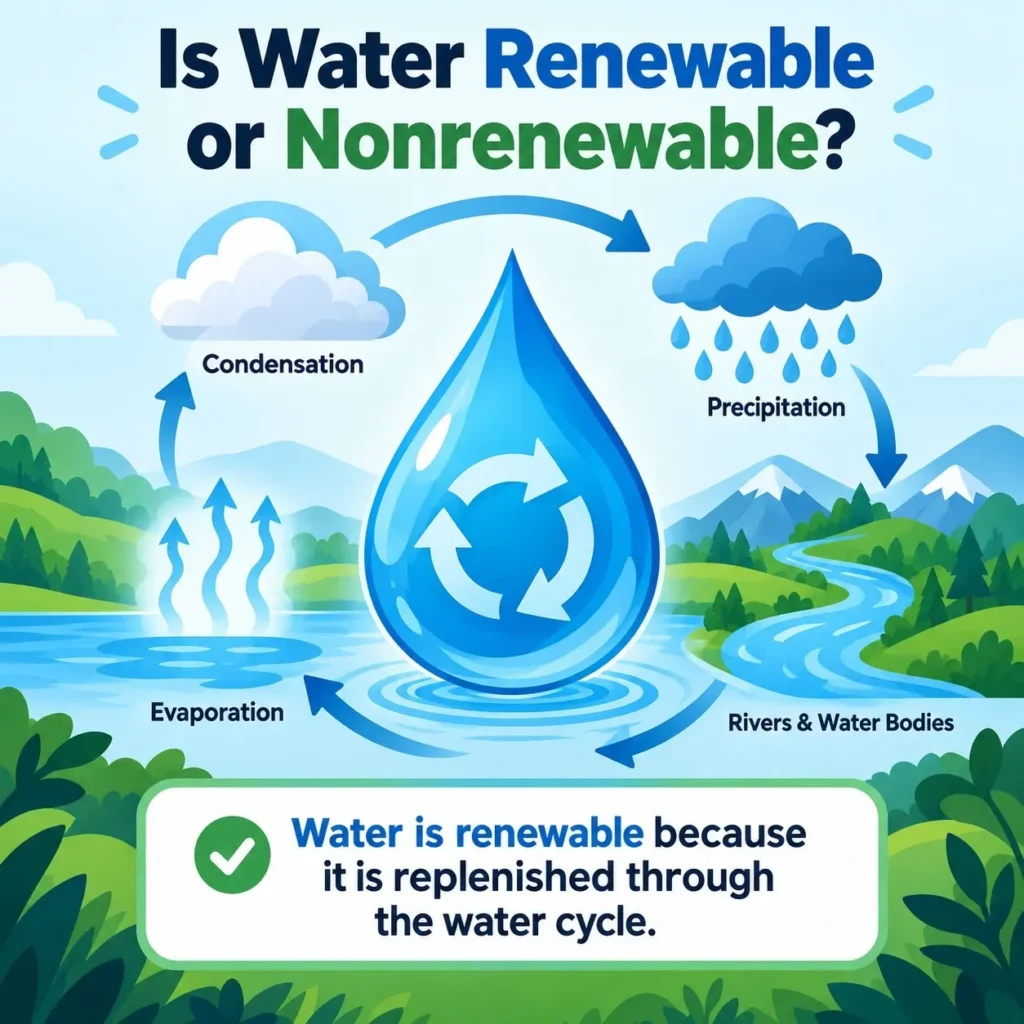
Let us give a clean answer. Ask is water renewable or nonrenewable, and the answer is renewable.
Using water does not destroy it. We drink it, and it leaves our body. When we wash, the water flows down the drain. Later it returns to rivers, clouds, and rain.
Why It Is Not Nonrenewable
Nonrenewable things are used up for good. When you burn oil, it is gone. When you use water, it only changes place or form.
So if a quiz asks is water renewable or non renewable resource, tick renewable.
The Small Exception
Some deep underground water is very old. Refilling can take hundreds, or even thousands, of years. If we use it too fast, it acts almost like a nonrenewable resource.
So the full answer to is water a renewable resource has two parts. Rain-fed water is renewable. Very deep, old water renews so slowly that we must treat it like gold.
Clean Water Is the Real Limit
Water can be renewable and still be unsafe. Dirty water cannot be used until it is cleaned. Nature cleans it, but only if we do not overload it with waste.
Is Water a Renewable Source of Energy?
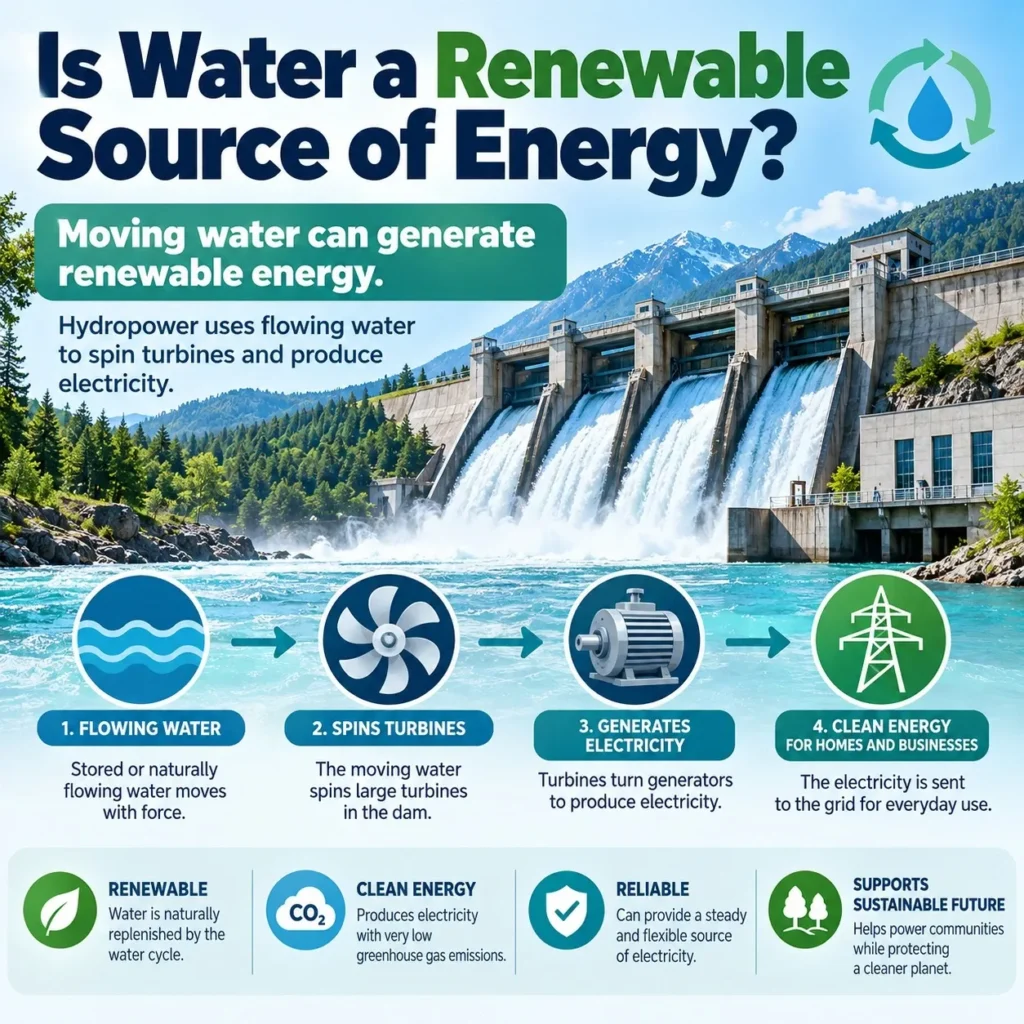
This is a different question. Many people mix it up. Let us split it into two ideas.
Water as a drink is a resource. Water as a power maker is an energy source. So, is water a renewable source of energy? Yes, in many ways.
Hydropower: Power From Moving Water
Hydropower is the most common way. A dam holds water high up. When the water falls, it spins a big wheel called a turbine. The turbine makes electricity.
Hydropower gives about one sixth of the power in the world. That is a big share. Many countries use it every day.
Tidal and Wave Power
The sea moves all the time. Tides rise and fall. Waves roll in without rest. Special machines can catch this motion and turn it into power.
These ideas are newer and cost more. But they show that is water a renewable source of energy has a strong yes.
Water Alone Does Not Make Energy
Here is a key note. Water does not burn like fuel. The power comes from its motion, which is pushed by the sun and the moon.
So when you ask is water a renewable source of energy, the full answer is: moving water is, and the water cycle keeps it moving.
Things to Keep in Mind
Dams can change rivers and harm fish. They can also force people to move. So even clean power has a cost. Good plans must care for nature and people.
Which of the Following Is a Renewable Resource? A Quick Test
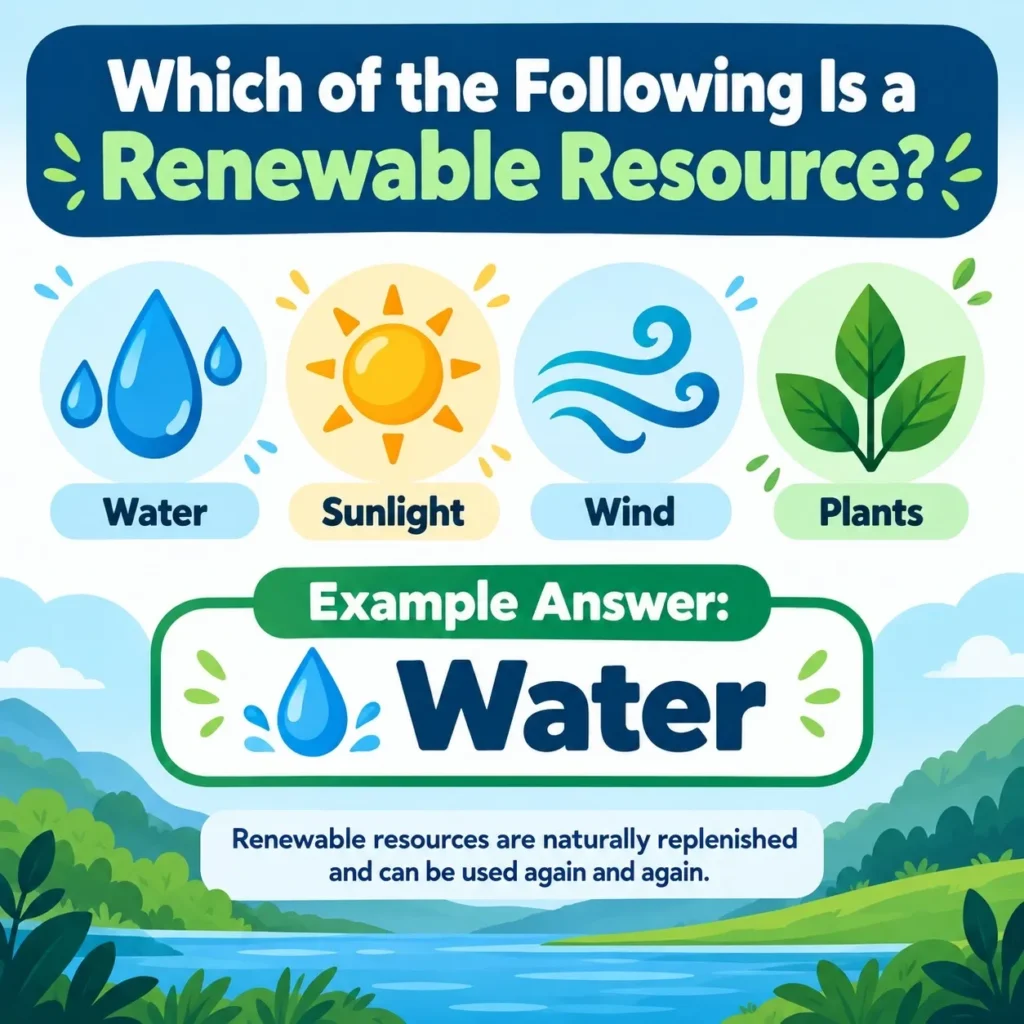
You may see this question in school or in an exam. Which of the following is a renewable resource is a common type of question. Let us make it easy.
Renewable Resources
These refill by themselves in a short time:
- Water (through the water cycle)
- Sunlight
- Wind
- Trees and plants (if we plant new ones)
- Fish (if we do not catch too many)
Nonrenewable Resources
These take millions of years to form:
- Coal
- Oil
- Natural gas
- Uranium
Tips to Answer Fast
Ask yourself two easy questions. Does it refill soon? Does using it stop it from coming back? If it refills soon, it is renewable.
So in a list with coal, oil, water, and gas, the right pick for which of the following is a renewable resource is water.
One Careful Note
Even renewable things can run out if we use them too much. Fish can disappear. Forests can shrink. Water can run low. Renewable means “can come back,” not “can never end.”
Fresh Water and Salt Water: What Is the Difference?
Both kinds are part of the cycle. But they are not equal for daily life.
Fresh Water
Fresh water is in rivers, lakes, ponds, and under the ground. It has very little salt. We use it to drink, cook, wash, and farm.
Salt Water
Salt water fills the oceans. We can make it drinkable with a process called desalination. It removes the salt.
But it needs lots of power and money. So most places use fresh water first.
Does Desalination Make Water Renewable?
It helps to make more usable water. But it does not change the main answer. In all cases, is water a renewable resource still gets a yes, because oceans are always refilled by the cycle.
Groundwater: The Slow Part of the Cycle
Groundwater is water that sits under the soil and rocks. We reach it with wells and pumps. Millions of families depend on it.
How Groundwater Refills
Rain soaks into the ground. It moves slowly down through soil and stone. Over time, it fills spaces deep below.
Why It Is Easy to Overuse
Pumps can pull water out very fast. But refilling is slow. In some places, the water level drops every year. Wells can go dry.
That is why experts ask people to pump less and to save rain. The goal is to take out no more than nature puts back.
Ways to Help Groundwater
- Collect rain from roofs.
- Dig small ponds to hold rain.
- Keep green land around homes so water can soak in.
- Avoid paving every inch of ground.
What Hurts Our Water Supply?
Water is renewable, but people can harm it. Let us look at the main problems.
Pollution
Waste from factories, farms, and homes can flow into rivers. Dirty water harms fish and people. It costs a lot to clean.
Overuse
Farms, factories, and cities all need water. If everyone takes too much, there may not be enough left for nature.
Weather Change
A warming world can change rain patterns. Some places get heavy floods. Others get long dry spells. This makes water harder to plan for.
Waste
A lot of water leaks from old pipes. A dripping tap may look small, but over a year it can waste many liters.
How Much Water Do We Really Use?
Water use is not just what comes from the tap. Food, clothes, and goods also need water to make.
A cup of tea, a shirt, and a bowl of rice all used water before reaching you. This hidden water is called virtual water.
Farming Uses the Most
Growing food takes the biggest share of fresh water in the world. So saving water in farms matters a lot.
Drip pipes, which give water drop by drop to plant roots, can cut waste. Mulch, which is a layer of leaves on soil, keeps the ground moist.
Homes Use a Smaller Share
But home habits still count. When millions of homes save a little, the total saving is large.
Easy Ways to Save Water at Home
You do not need fancy tools. Small habits work well. Try these.
In the Kitchen
- Wash fruit in a bowl, not under a running tap.
- Use leftover water for plants.
- Run the dishwasher only when it is full.
In the Bathroom
- Turn off the tap while you brush your teeth.
- Take shorter showers.
- Fix leaks fast. A leaky toilet can waste a lot.
In the Garden
- Water plants early in the morning, when it is cool.
- Use a bucket instead of a hose to wash a car or bike.
- Plant local trees and plants. They need less water.
Collect Rain
A barrel under a roof pipe can hold rain for your garden. It is free water. It also reduces the pressure on rivers and wells.
When more people act like this, our planet can keep up. That is how we make sure is water a renewable source of energy and is water a renewable resource both stay true for our children.
What Can Cities and Leaders Do?
Homes matter, but big plans matter too. Here are some good steps.
- Repair old pipes so less water leaks.
- Clean waste water and use it again for farms.
- Protect forests, lakes, and wetlands, which hold and clean water.
- Set fair rules for pumping groundwater.
- Teach children about water in school.
Myths About Water
Let us clear up a few wrong ideas.
Myth 1: “Water Can Never Run Out”
Not true. The cycle never stops, but local supply can drop. Many cities have faced shortages.
Myth 2: “Water Is Nonrenewable Because We Drink It”
Not true. When we drink water, our body uses it and then lets it go. It returns to the cycle. So if someone asks is water renewable or nonrenewable, the answer stays renewable.
Myth 3: “The Ocean Is Endless Drinking Water”
Not true. Sea water is too salty to drink. Making it safe takes a lot of power and money.
Myth 4: “My Small Habits Do Not Matter”
Not true. A small saving, repeated by many people each day, becomes a very big saving.
Frequently Asked Questions (FAQ)
1. Is water a renewable resource?
Yes. Water moves in a cycle. The sun lifts it, clouds carry it, and rain brings it back. So is water a renewable resource has a clear yes. But we must not waste it.
2. Is water a renewable source of energy?
Yes. Moving water can spin a turbine and make power. Dams, tides, and waves all use this idea. So is water a renewable source of energy has a yes for moving water.
3. Is water renewable or nonrenewable?
It is renewable. Using water does not destroy it. It goes back into the cycle. When people ask is water renewable or nonrenewable, the answer is renewable, with care for supply and clean water.
4. Which of the following is a renewable resource?
Water, sunlight, wind, and plants are renewable. Coal, oil, and gas are not. So in any list, the answer to which of the following is a renewable resource is the one that refills fast.
5. Is water renewable or non renewable resource when it is underground?
Mostly renewable, but slow. Some deep groundwater takes hundreds of years to refill. So is water renewable or non renewable resource has a renewable answer, with a warning to use deep water wisely.
Final Thoughts: Respect the Water We Have
Let us look back. Water moves in a loop. The sun lifts it, clouds carry it, and rain returns it. That is why the best answer to is water a renewable resource is yes.
But it is not endless. Most water is salty. Fresh water is not shared evenly. Deep groundwater refills very slowly. So we must use water with care.
For exams, remember this. When you see which of the following is a renewable resource, water is a good pick. And when you see is water renewable or non renewable resource, write renewable.
Start with one small habit today. Fix a leak. Close a tap. Collect some rain. Every drop saved helps the cycle keep going.
